A drain that backs up raises two questions at once: how do you stop it, and whose job is it to fix? In Port Colborne the answer to the second depends on where the blockage sits, who owns that length of pipe and whether you own the house or rent it. Deal with the first question first, then work through the second one step by step.
What should you do first if a drain is backing up?
Before you work out who is responsible, do these few safe things:
- Stop using water anywhere in the house. Don't flush, and don't run the washer, the dishwasher or any taps. Water from every fixture ends up at the same place, so more water makes the backup worse.
- Keep away from standing water near outlets, extension cords or the furnace. Only switch off the breaker for that area if you can get to the panel without crossing wet floor.
- Take photos of the water, the drain it came from and anything that got wet. Your insurer will want them, and if you rent, so will your landlord.
- If you rent, tell your landlord right away, in writing if you can. A text or email gives you a dated record.
Most backups can wait a little while you find someone to clear them, as long as nobody is using water. A backup that keeps rising when no water is running in the house is different. It usually means the problem is further down the line, possibly the City's main, and you shouldn't leave it.
Which part of the sewer line does the homeowner own?
The City of Port Colborne runs about 90 kilometres of sanitary sewer mains. They carry wastewater to Niagara Region pumping stations and on to the Seaway Wastewater Treatment Plant. The City looks after the main under the street and the connection from the main to your property line. You, as the owner, are responsible for the sewer service from the property line to your house. Your water line is split the same way: the City's part runs from the main to the property line, and yours runs from there to the house.
In practice, the owner is responsible for:
- every drain and fixture inside the house
- the drain under the basement floor and the floor drain
- the sewer lateral under the front yard, up to the property line
The City is responsible for the main under the street and the short piece between the main and your property line. If you're unsure where that line falls at your address, the City can tell you.
How can you tell which side the blockage is on?
A few clues will point you in the right direction before anyone opens a cleanout:
- If one sink or one toilet drains slowly, the blockage is almost always inside the house, close to that fixture.
- If several fixtures are slow, or the floor drain backs up when the washer empties, the problem is in the main building drain or the lateral, which is still your pipe.
- If neighbours on the same street have water coming up their floor drains during the same storm, the public sewer may be overloaded. Report it to the City as well as dealing with your own basement.
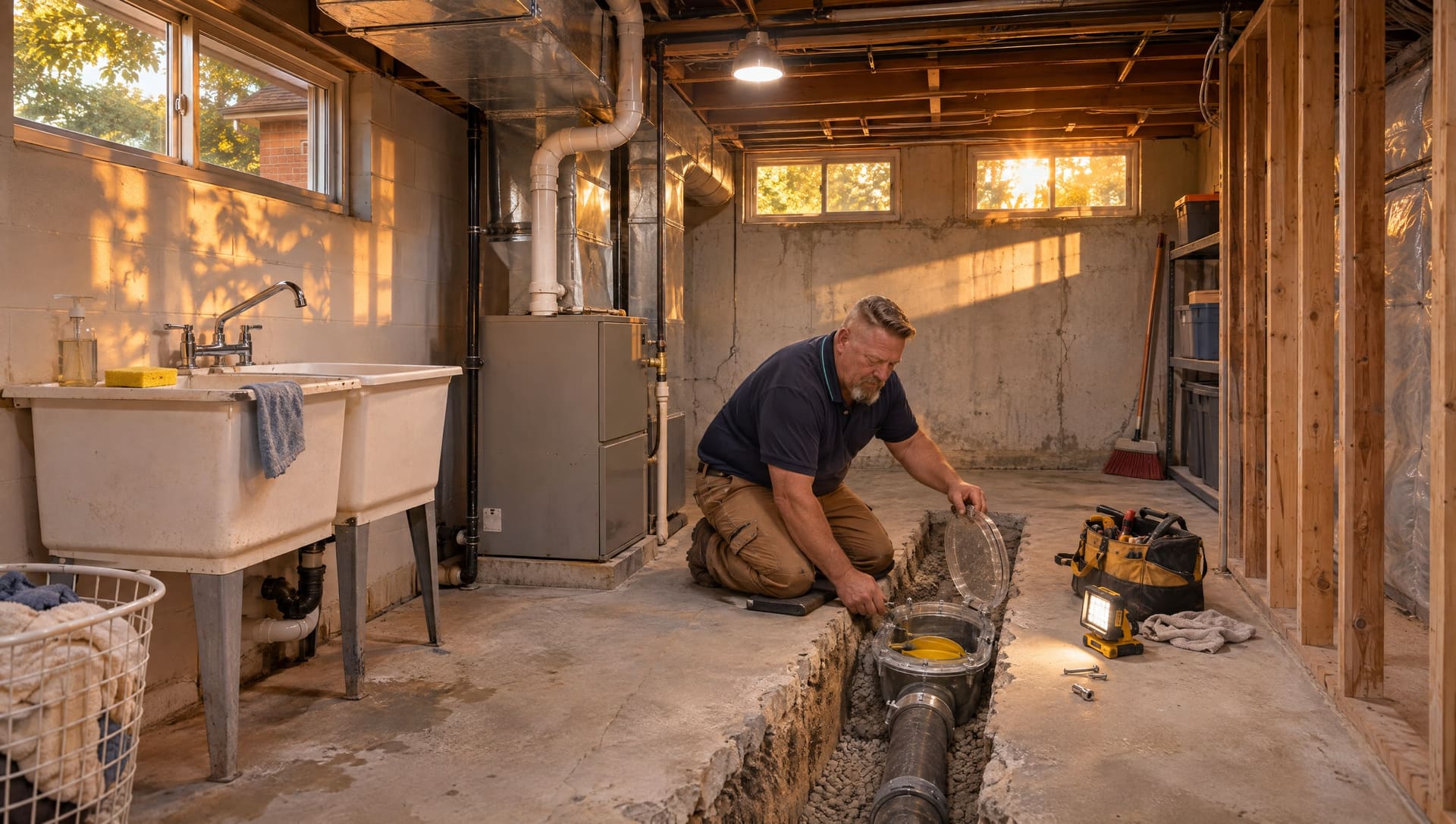
The surest answer comes from a sewer camera. It's fed in through a cleanout, and it shows what the blockage is and how far from the house it sits. That distance, measured against the property line, tells you whether the problem is yours or the City's.
How does the age of your house change the answer?
Port Colborne was built in three broad waves, and houses from each one tend to block in their own way.
- The oldest houses, before 1945. This includes the original settlement, the vacation homes on Tennessee Avenue and the former Village of Humberstone. These houses usually started out with cast iron drain stacks and clay sewer laterals, and a basement floor drain that runs straight to the sewer. Tree roots get into clay joints, and old laterals can sag or collapse. A drain that blocks again every few months in one of these houses is often a lateral problem, so a camera look is worth it before you pay for another round of clearing.
- Post-war houses, 1945 to the 1970s. Around Barrick Road and Olga Drive, laterals are often clay or fibre, and the foundation weeping tile is often tied into the sanitary sewer. So in heavy rain, groundwater from around the foundation goes into the same pipe as the household waste. Port Colborne gets about five days a year with 25 mm of rain or more, and those are the days these basements tend to back up.
- Newer subdivisions, 2010s onward. In Westwood Estates, Rosedale Estates, Mapleview, Millar's Crossing and similar areas, the drains and laterals are usually plastic. A sump pump handles the foundation water, and there's often a backwater valve on the sewer. Backups here are less often a blocked pipe and more often a backwater valve that hasn't been cleaned or checked. Our guide on finding and checking a backwater valve walks through it.
Who is responsible for clogged drains, tenant or landlord?
In Ontario, the general rule is that the landlord keeps the plumbing in good repair, including the drains and the owner's section of the sewer line. Tenants are responsible for damage they or their guests cause through careless use.
In practice:
- If a lateral is full of roots, a clay pipe has collapsed or a drain stack has rusted through, the landlord is responsible. That's ordinary wear on the building.
- If a toilet blocks because wipes, toys or other things were flushed, the landlord may reasonably ask the tenant to cover the cost of clearing it.
- If grease poured down a kitchen sink causes a blockage, it can go either way. A plumber's note on what came out of the line usually settles it.
Whatever the cause, a tenant shouldn't hire their own contractor to dig up or replace pipe. Report the problem and let the owner arrange the repair. If a landlord won't deal with a backup, Ontario has a process for tenants to raise maintenance problems, and keeping your written notices and photos will help if you need to use it.
What is drain cleaning, and when is it not enough?
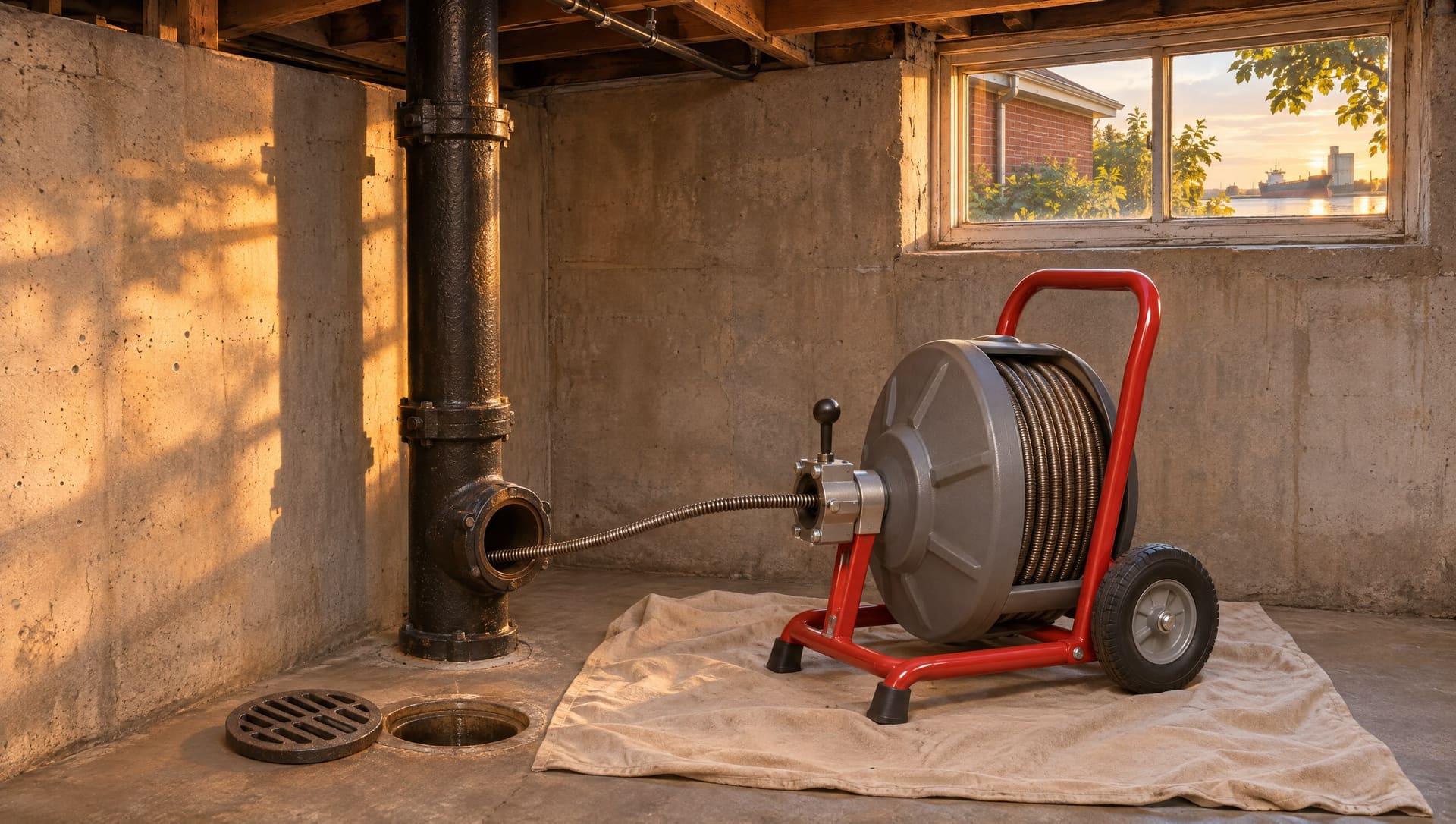
Drain cleaning means clearing a blockage out of a pipe without replacing it. A plumber feeds a cable with a cutting head through the line, or uses water under high pressure to scour it. Cabling suits most blockages. Water jetting is better for grease, sludge and fine roots along the pipe walls.
Clearing the line is the whole job if the pipe is sound and the blockage was grease, hair or something that shouldn't have gone down. It isn't enough if the cable brings back roots, or if the same line blocks again within months. That points to the pipe itself, and in older Port Colborne houses that usually means the clay lateral. A camera inspection after clearing shows whether the pipe is cracked, offset or sagging, so you can decide on a repair with the facts in front of you. See drain cleaning for how this usually goes.
Are there City grants for the owner's part of the line?
Port Colborne has two programs for owners:
- Private service line grant. For existing homes, the City offers grants towards replacing the private water line and sewer line, the part from the property line to the house. The City points out that many older water and sewer lines may contain lead.
- Basement flooding grant. Residential owners who get a City water and wastewater bill can apply for a grant towards disconnecting weeping tile, downspouts and sump pump connections from the wastewater system, and towards installing a sewage backflow prevention device. It depends on available budget, and the work has to be approved by the City before it starts. Work is performed by licensed plumbers (306A Certificate of Qualification).
A few rules to know before any digging:
- Changes to drains generally need a building permit, and the City's building department will tell you whether your job does.
- Before anyone digs, a locate has to be requested through Ontario Dig Authority. Public locates don't mark private lines such as your own sewer lateral, so whoever does the work will need to find it another way, often with the sewer camera.
A short way to think about it
Inside the house and under your yard, the pipe is yours. Under the street, it belongs to the City. If you rent, the landlord looks after the pipe and you look after what goes down it. If you're not sure which applies, a camera inspection will show you where the blockage is.
If a drain in your house is slow or backing up, Port Colborne Plumber can clear it and show you where the problem is through our drain cleaning service.