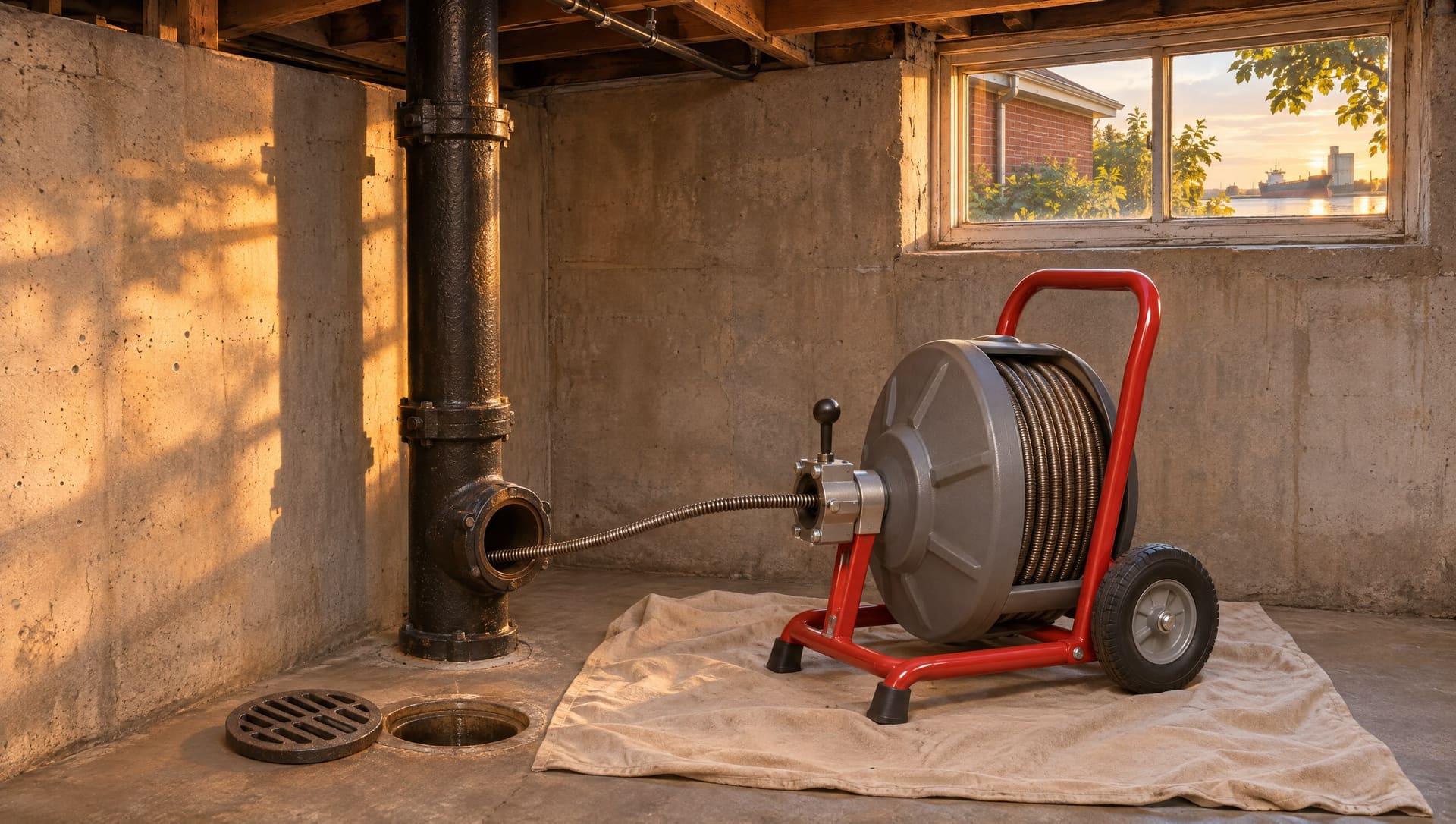
If the floor drain is backing up right now, start with two things. Stop using water in the house: no flushing, no laundry, no dishwasher. Then keep away from any water that is near an outlet, a power bar or the furnace. Everything below can wait until the water has stopped rising.
If your basement is dry and you are reading this to prepare, now is a good time to find out whether your house has a backwater valve. It only takes a few minutes.
What is a sewer backflow valve?
A backwater valve, also called a sewer backflow valve, is a fitting on the main drain that carries everything from your house out to the street. Normally it stays open and the house drains as usual. When the City's sanitary sewer fills during a heavy storm and water starts to push back towards your house, a flap inside the valve closes. Sewage then stays in the sewer and does not come up through the lowest drain in your basement.
This matters in Port Colborne because heavy rain is a regular event. Environment Canada's 1981 to 2010 normals for the Port Colborne station show about 985 mm of precipitation a year, with about five days a year bringing 25 mm of rain or more. A downpour like that puts a heavy load on the sewers. Most houses never see a backup. When one does happen, though, it usually comes up through the basement floor drain first.
How do you know if your house has a backwater valve?
Start in the basement, at the front of the house or whichever side faces the street. Your main drain usually leaves the house on that side.
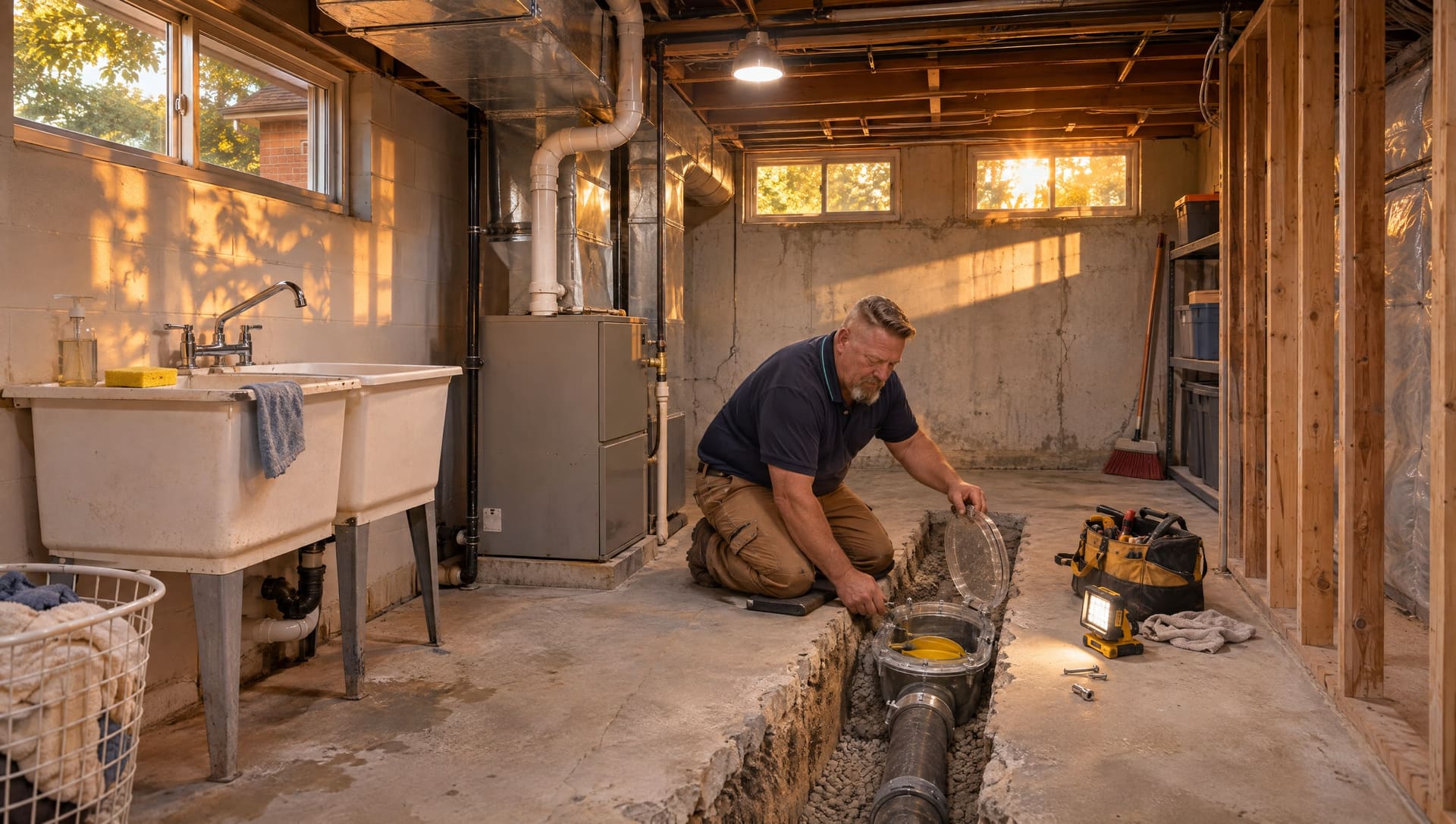
- Look for a round or rectangular cover set flush into the concrete floor, often plastic and sometimes with a clear lid. It is usually in the utility room, near the floor drain or under the stairs.
- If the lid is clear or comes off easily, look inside. You should see a flap or gate sitting in the line, and the water should run through freely.
- Check the house papers: a home inspection report, the original builder's documents, or permit records from the City's building department.
- In a finished basement, the cover may be under carpet, laminate or a storage shelf. If there is no access panel anywhere, the valve may not exist, or someone may have covered it over. Either way, it needs to be sorted out.
A small rubber plug or float sitting inside the floor drain is not the same thing. It protects that one drain only. A mainline backwater valve protects every fixture in the basement.
The age of the house is a good clue too:
- Before 1945 (the original town, the Tennessee Avenue cottages and Humberstone). These houses were usually built with a floor drain running straight to a clay sewer lateral and no sump pump. Unless a valve was added later, assume there is none.
- 1945 to the 1970s (Barrick Road and the older lots around Olga Drive). There is usually no valve, and the foundation weeping tile is often tied into the sanitary sewer. These houses tend to back up in heavy rain.
- 2010s onward (Westwood Estates, Mapleview, Rosedale Estates, Millar's Crossing). These houses often have a backwater valve already, along with a sump pump. The usual problem here is a valve that has never been opened or cleaned.
Where should a backwater valve be installed?
The Ontario Building Code sets the rule in Part 7, Article 7.4.6.4. A backwater valve is required where a building drain may be subject to backflow: on drains serving fixtures below the level of the street, or to protect fixtures below the upstream sanitary manhole cover in a house served by a public sanitary sewer. That describes most Port Colborne basements with a floor drain, a laundry tub or a basement bathroom.
In practice, a good installation has a few things in common:
- It sits on the main building drain inside the house. It goes downstream of the basement fixtures it protects, so their water passes through it on the way out.
- It stays accessible, with a cover you can lift, because it needs cleaning.
- It is planned together with the weeping tile. In many post-war houses the foundation drains run into the sanitary sewer. If they join the drain upstream of the valve, the closed valve traps that groundwater as well, and it can come up through the floor instead. That is why a valve is often installed at the same time the weeping tile is disconnected and sent to a sump pump.
Adding a valve means cutting into the main drain under the floor, so the work generally needs a building permit. The City's building department can tell you whether your job does. The valve is inside the house, but if any of the work moves outside to the lateral, a locate has to be requested through Ontario Dig Authority before anyone digs. Public locates do not mark your own private sewer line, so it helps to know where yours runs.
Which part of the line is yours?
The City of Port Colborne runs about 90 kilometres of sanitary sewer mains. It is responsible for the line from the main to your property line. The owner is responsible for the sewer service from the property line to the house, and that includes the backwater valve. Our guide on who is responsible for a blocked drain or sewer line explains this split in more detail.
Is there help from the City?
Yes, there is. If you get a water and wastewater bill, the City of Port Colborne offers a grant towards installing a sewage backflow prevention device. The same grant can also go towards disconnecting weeping tile, downspouts and sump pump connections from the wastewater system. It depends on the budget available that year.
The work must be done by a plumber or drain contractor and approved before it starts. So apply first and book the work after. Work is performed by licensed plumbers (306A Certificate of Qualification).
The City also offers separate grants for replacing the private water line and sewer line on older homes. These are worth asking about if your lateral is old clay.
How do you look after a valve you already have?
A valve only works if the flap can close. Lift the cover twice a year, ideally in spring and again before the fall rains. Make sure the flap moves freely and nothing is caught under it, and rinse away any build-up. If you can't get the cover off, or the flap seems stuck, that can wait for a planned visit. It should not wait until the next storm warning.
While the valve is closed during a storm, your own drains cannot empty either. Keep water use to a minimum until the street sewer drops back down.
What does sewer backup coverage cover?
Nothing in this section is specific to Port Colborne, so treat it as general guidance and check your own policy.
- On most home policies in Ontario, sewer backup is an optional add-on, not part of the basic coverage. Ask your broker whether you have it, what the limit is and what deductible applies.
- It usually pays for damage caused by water or sewage backing up into the house through the drains: cleanup, flooring, drywall and damaged belongings, up to the limit.
- It usually does not cover overland flooding from surface water (often a separate add-on), slow seepage through the foundation, or repairs to your own sewer pipe.
- Insurers often ask whether the house has a backwater valve, and some take it into account when setting the terms.
If you install a valve, keep the permit, the invoice and a photo of the installed valve, and send copies to your insurer. After a backup, take photos before you clean up and call your insurer before you throw anything away.
What can wait, and what should not?
If you have a valve and it opens and moves freely, nothing needs doing beyond your twice-yearly checks. If you have no valve and your basement has never had water in it, take your time. Apply for the grant, get a written price and plan the work for a dry month.
Two situations are worth acting on sooner. One is a house that has already backed up. The other is a post-war house where the weeping tile probably feeds the sanitary sewer. In both cases, the next heavy rain is likely to bring the same result.
If you want someone to find your valve, check it or plan an installation with the grant, see sewer repair and backwater valves.